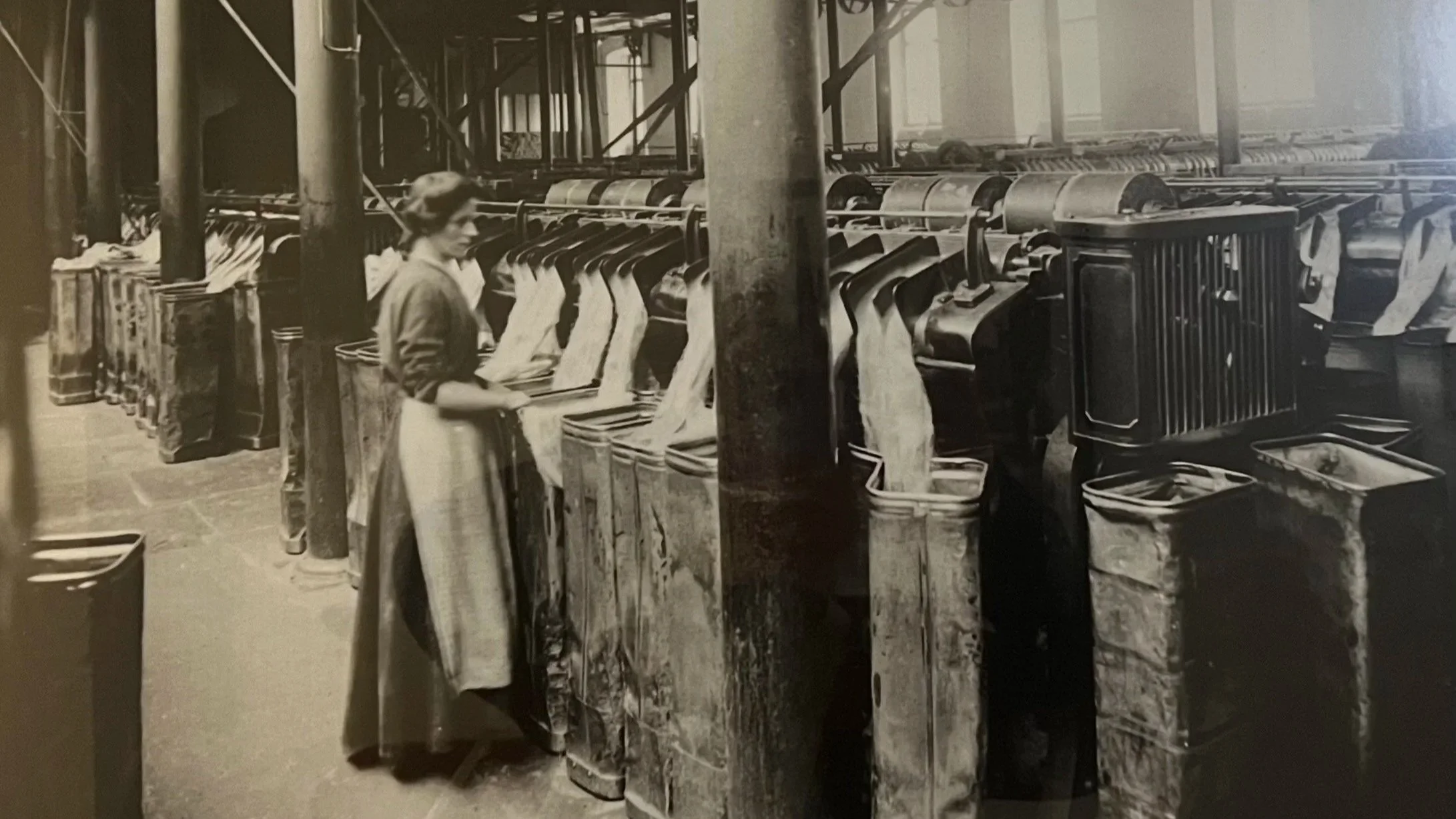
Talking Threads
Exploring Scotland's textile heritage through research, storytelling and collaboration
Project Overview
Talking Threads is a collaborative research and public engagement project exploring Scotland's rich textile heritage and the stories woven into the fabrics, garments and making traditions that have shaped our cultural identity.
Developed by Scotland Re:Design in partnership with researchers, makers, cultural organisations and heritage specialists, the project brings together historical research, contemporary craft practice and public interpretation to reveal the enduring connections between fashion, textiles and Scottish communities.
Through exhibitions, creative responses and collaborative research, Talking Threads demonstrates how Scotland's textile heritage continues to inspire contemporary makers while preserving knowledge for future generations.
The Challenge
Scotland has a globally significant textile history, yet many of the stories behind the country's makers, materials and manufacturing traditions remain underrepresented or inaccessible to wider audiences.
Talking Threads set out to explore how fashion and textile heritage could be interpreted in new ways, making research more engaging and encouraging conversations between historians, makers, designers and the public.
The project asked how historical knowledge could inform contemporary practice while celebrating the people, places and skills that have shaped Scotland's creative identity.
The Research
Working collaboratively with researchers, historians, makers and partner organisations, Talking Threads explored the social, cultural and material history of Scottish textiles through archival research, creative interpretation and public engagement.
The project investigated traditional techniques, regional identities and the relationship between heritage and contemporary design, demonstrating that historical research can become a catalyst for innovation and creative practice.
By connecting academic research with lived experience and contemporary making, the project encouraged new perspectives on Scotland's fashion and textile history.
Exhibition & Public Engagement
Research formed the foundation of a public exhibition that invited visitors to explore Scotland's textile heritage through objects, interpretation, creative responses and contemporary practice.
Alongside the exhibition, Talking Threads created opportunities for dialogue between project participants and audiences, encouraging visitors to consider how fashion, craft and heritage continue to influence modern Scotland.
The exhibition demonstrated how cultural heritage can be experienced through both historical interpretation and contemporary creativity.
Project Impact
Talking Threads demonstrated the value of collaboration between heritage organisations, researchers and creative practitioners.
The project:
Celebrated Scotland's textile heritage through public engagement.
Connected historical research with contemporary fashion and craft.
Created opportunities for interdisciplinary collaboration.
Encouraged conversations around heritage, identity and sustainability.
Supported greater appreciation of Scotland's rich textile traditions.
By bringing together research and creative practice, Talking Threads reinforced SR:D’s commitment to preserving heritage while inspiring the future of Scottish fashion.
Partners & Contributors
Talking Threads was made possible through collaboration between researchers, museums, heritage organisations, designers, makers and cultural partners.
The project brought together expertise from across the heritage and creative sectors, demonstrating the value of partnership in uncovering and sharing Scotland's textile stories.

Talking Threads is about the herstories and hidden tales of Scottish music and fashion from medieval textiles and fashion to post-industrial and contemporary practices. The project is ongoing due to huge interest, and we are still collecting stories for more projects to come from this. Read on to uncover our work and share each other’s stories and send us yours.
An initial pilot exhibition as part of Scotland’s Year of Stories was hosted, suitably, in the former Coats Viyella shop from 16th to Sunday 20th November at Dundee’s Overgate Shopping Centre’s community Gather Space up on Level 1, with outlying displays within V&A Dundee in their Shop during the Scottish Fashion Festival 2022.
Coats-Viyella was a late 20th Century popular clothing brand, established from the original Coats thread business from Paisley, whose history in weaving, lace and cotton predates the famous shawls. Both still going independently, the brand’s retreat from on street premises eventually formed part of the paradigm shift in Scottish fashion and textiles which began from the 1980’s onwards. With The Herald quoting that the industry was losing 500 jobs a week in March 1999, in 2020 updated figures showed nearly 30,000 employed in the Scottish sector, with a whole army of freelancers and sole traders on top of that, contributing more than £2.8 billion to the economy (Fashion Roundtable/ONS).
The exhibition strand was supported by the Year of Stories 2022 Community Stories Fund. This fund was being delivered in partnership between VisitScotland and Museums Galleries Scotland with support from National Lottery Heritage Fund thanks to National Lottery players.
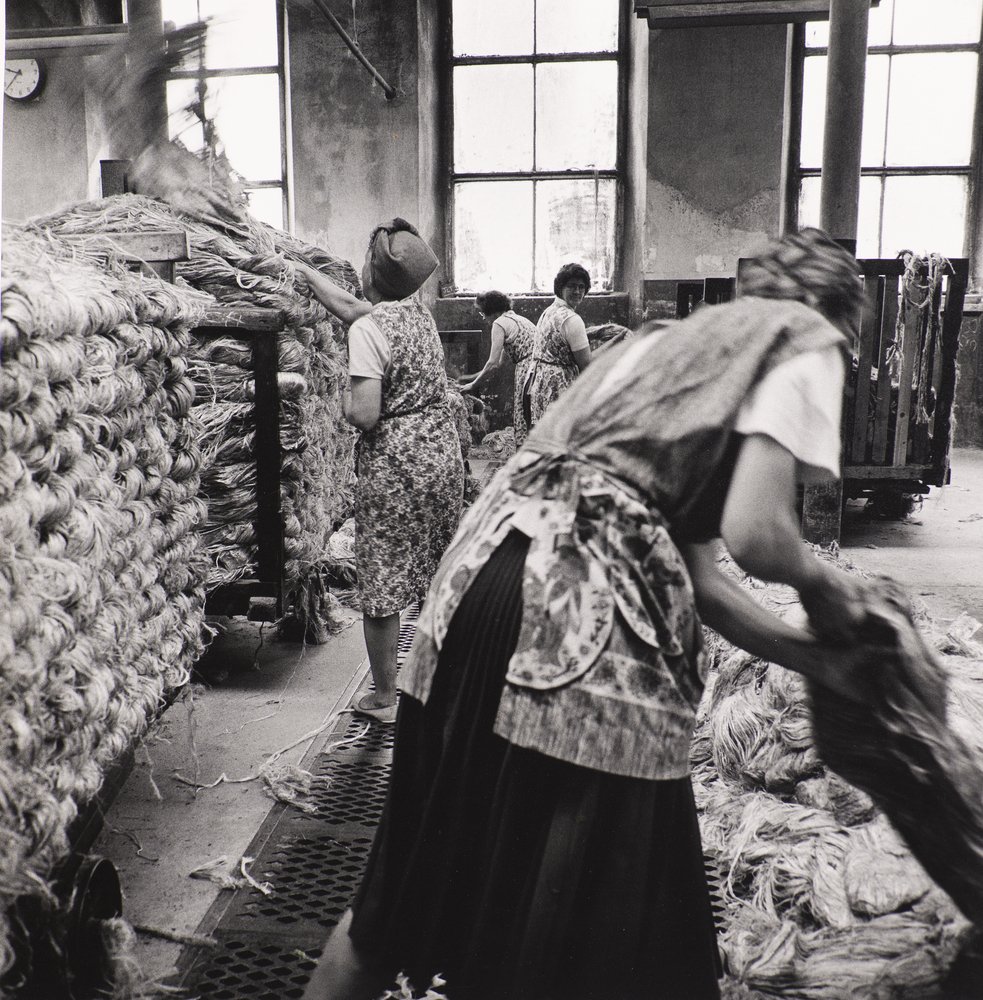
Copyright / on loan by kind permission of the family and estate © The Joseph McKenzie Archive, thanks to The McManus: Dundee’s Art Gallery and Museum
Talking Threads
Hidden Tales of Scotland’s Fashion & Music
Initially curated by SR:D as part of the Year of Stories 2022, the Talking Threads exhibition looked for hidden stories and musical connections behind textile working practices, in a sector which has always mainly featured women workers. We connected threads between women working to produce Scotland’s historic fashions and textiles, through the soundtrack of the pre-industrial era, and the post-1960s to 90s, up to current playlists for Scotland’s contemporary design studios.
Scotland has an incredibly rich textile and fashion history, recognised and celebrated the world over by designers, customers and creators, especially from those choosing to live and work in Scotland.
In a big shift from the exodus of the 90s and 2000s to London and beyond, the industry is now attracting people in and is worth over £2.8billion a year to the Scottish economy. It features an array of talent ranging from designers and manufacturers to international models, make-up artists, producers, museums, shops and photographers.
SRD’s exhibition showcased initial research that discovered key stories from across these three major musical eras of Scottish traditional craft textiles and fashion practices for new audiences. Weaving these story threads together to produce a rich tapestry demonstrating what people's lives were really like, the music they listened to, the work they did and how each made an impact on society.
Stories from each era guide us through a historical journey with consideration of the tools that were used and the kinds of fashion and textiles that were produced. We also explored the people behind the fabrics, especially by hearing stories from those involved in production and learning who they were making the clothing for.
What we found in our research for this project is that almost anyone you ask can cite a link to the Scottish textile industry at least once across the three eras we have identified. We are really keen to continue this project, so please do get in touch if you have a story you would like to share. This initial exhibition was just the start of something. Stay tuned to see where the thread weaves next.
This event has been supported by the Year of Stories 2022 Community Stories Fund. This fund is being delivered in partnership between VisitScotland and Museums Galleries Scotland, with support from the National Lottery Heritage Fund, thanks to National Lottery players.
Did you, or someone you know, work in a Scottish Mill or Factory? We would love to hear from you and to build on our picture of the industrY.
Please contact us now with your tales and recollections, photos or videos about your experiences from Timex to crafts, shops, factories and studios.

PRE-INDUSTRIAL GROUP WORK & Handmaking
While it is impossible to determine exactly when humans began wearing clothing, we can track back historical fashions over several thousand years. Up until the 1700’s, when the first mill was built in Scotland, to be exact, every garment would have been made entirely by hand. Every item of clothing would have been a treasured possession, taken care of and often repaired again and again.
Going back to the earliest examples of garments we know of, they would have been made by and for individual families, and mostly by women. Even at this stage clothing would have had an element of self-expression, often including embellishments and decoration. Moving through to the collaborative efforts of the weavers and knitters in the Scottish Highlands and islands, textiles would have been about community and socialising. In the Hebrides women famously would have gathered to wash their woven fabrics and sang ‘waulking songs’ together as they worked.
Waulking songs continued to be sung by women in some parts of Scotland right up until the 1960’s. Their popularity has secured Scotland as one of the richest gold stores of traditional music in Western Europe. Interestingly, despite having languages formed from the same roots, and a similar history around skilled tweed workers, the Irish have never sung waulking songs. The only other place in the world where they are sung is Nova Scotia, in Canada - no point for connecting the dots there. A key difference between the countries were that In Scotland you’d only expect to see women singing the songs, using their hands to keep the beat, whereas across in Canada you’d also find them sung by men, who used their feet.

Image: Julie Howden, Model: Model Team, Kilt: Siobhan Mackenzie
The most iconic of Scottish textiles is tartan; a kilt being a symbol of Scotland the world over. These modern terms are, of course, not native to Scotland, those came later, and were introduced by our neighbours to the South. Ancient Scots would have worn and carried a ‘plaid’. Despite the modern proclivity to link particular colours to family names, the variations in plaid colours would have been linked to the land rather than the man. The materials and dyes available would have all been natural, with dyes made from whatever plant matter was locally available. The plaid was an item used for warmth like a blanket, as well as worn in all weathers, or for carrying items over a shoulder like a bag.
In order to make a garment, our forebears would have had to go through a series of processes, first gathering fibres from plants or animals, turn those materials into yarns using combs and carders, and then weave those yarns into fabric using stone weighted spindles. Doing each stage by hand, with primitive tools, would have taken extensive amounts of time, so it’s no wonder those items were well taken care of.
From cottage industries to mercantilism where exchange was starting to grow and fabrics would be traded from one area to another, developing international links with India and so on over time. The export of fabric continued to expand as we built an international name for textiles.
POST-Industrial COMMUNITIES & CHANGE
As the industrial revolution washed over Scotland, the rise of mills and factories as people left the countryside is what created many of our towns and cities as we know them today, or more accurately - as they were in the Victorian and Edwardian eras, through the World Wars differently as factories were turned to war effort, and until the 1980’s. From the world-famous Coats factories in Paisley, the Calton weavers in Lanarkshire, and the Singer sewing machine factory in Clydebank, to name but a few. The development of new technologies was phenomenal and bled across into other industries too. Did you know the first ever computer programmer was a weaver? Ada Lovelace used the technology from a weaving card to create the first ever algorithm.

Dan Coughlin demonstrating the depth of the Paisley Museum archive in front of a still in use loom
The first inventions which increased the speed of fabric production included the spinning jenny, a multi- spindle spinning frame, one of the key developments in the industrialisation of textile manufacturing. And the flying shuttle reduced the amount of manual manoeuvring required by workers. This later developed into using the power of water to run huge mechanical looms. With the arrival of electricity, sewing machines and modern textile technology meant the processes could be automated to some extent, making it much safer, and much faster to produce fabric and clothing. The very first water powered mills required children to work as they were small enough to fit between the machines to untangle and repair any faults. The growth of the textile industry also opened opportunities for women to enter paid employment, albeit often at lower rates of pay than their male counterparts.

Weavers' Struggles ... The Calton Weavers' Massacre, painted by Ken Currie in 1986
As demand for garments grew, increasing pressure was put on the workers, whose conditions were often very poor. This led to the first major industrial action in Scotland’s history, the Calton weavers’ strike in 1787. Celebrated as working-class martyrs, whose strike achieved fundamental changes between workers and employers, the Calton weavers’ have been immortalised in a painting by Glasgow artist Ken Currie to mark the 200th anniversary of the event. In the decades to follow many more mill workers staged strikes to fight for better working conditions and pay. An 1820 strike by Paisley textile workers was combined as part of the continuing movement for the right to vote. In Dundee there was a 1912 Jute strike, part of a wave of strikes across the whole United Kingdom, with workers demanding ‘We will never be content, ‘til we get our ten percent.’

Workers from the Paisley mill on their way to the picket line during the 1950’s strike
Around the same time as the Dundee strike, Mary Brooksbank wrote the most famous of her many mill songs. These songs were sympathetic to the struggles of her mill co-workers, who were mostly women. Hardworking, low paid, yet highly skilled women kept their positions on so they could feed their children. In her famous ‘Jute Mill Song’, Brooksbank also shared the inner workings of a day on the ‘flett’ (flat, or mill floor). Shiftin, piecing, and spinning were the main daily tasks, which contributed to making the Jute.
A historical gem in Scotland’s textile story is New Lanark Mill. While other mill owners were putting profit before the welfare of their workers, Robert Owen tried to buck the trend by ensuring that working conditions were reasonable and that children of families had access to education.
The industry began to falter in the late 20th century. When manufacturing started to be moved over to India and other countries, where it was much cheaper to produce fabrics, jobs dried up and mills began to close their doors. More recently in 1981 workers from Lee Jeans staged a sit in, which actually prevented the factory in Greenock from closing for some while at least. Their success recently celebrated its 40’s anniversary with a BBC documentary which chronicled stories of many of the women who worked there.
The music that was charting at the time of the sit in was quite apt for the mood of it all. Coming of the back of the punk movement, with bands who rejected the mainstream, were often political, and embraced DIY efforts to release music. In particular, the people we spoke to associate the likes of the Clash and Madness during the time that the women occupied the factory. Dundee had a similar story with Timex - another fashion accessory stripped and sent abroad for profit, and it’s no huge surprise to hear that disco moved to punk and rock for many.
Throughout the industrial era the manufacturing of clothing drastically changed, being produced at increasing speeds with consumers encouraged to buy more and more. This attitude to clothing stands in marked contrast to the value placed on hand made clothing of the pre-industrial era, or to the current days. Individual expression became intertwined with trends, with pressure on consumers to have the latest fashions, as documented by Naomi Klein in her book No Logo. In the 1980s de-industrialisation was a national strategy under the Thatcher Government in the UK, and the textiles industry was one of the most devastated at this time. The song Letter from America captures this period of devastation in Scotland, becoming a chart hit in 1987 and lamenting this most recent wave of economic migration from Scotland.
Contemporary SHARED STUDIO practice & HANDMAKING
As the fashion and textile industry has developed into the 21st century, it has followed divergent paths. Trends associated with globalisation, including industry relocating to sites where labour is cheaper, and an ever-quickening trends cycle had already led to mass, often over-production. This has meant that clothing has become disposable to many, and therefore detrimental to the environment. This mass produced ‘fast fashion’ is still a feature of our high streets. However, consumers are also questioning ‘who made my clothes?’ and asking for transparency about working conditions in the factories. During the COP26 conference last year in Glasgow, attention was brought to the textile industry and its impact on the environment.
Given these concerns, more and more designers are choosing slow fashion, made for local customers, with sustainable practices at the heart of their ethos. Our research engaged a wealth of Scottish designers, factories and mills, who are at the centre of what SR:D is all about, and connecting them with audiences. There is an exciting and hopeful resurgence of interest in traditional artisanal techniques, in mending and repairing, and in preserving our heritage.
We celebrate the wonderful mills that have survived right through to today, some of which still produce garments and textiles using traditional methods, and have developed new techniques and designer partnerships for collections, many of which feature in the Scottish Fashion Festival, and other Scotland Re:Design showcases and runways. Despite the change, the quality waxed cloth, tartan, cashmere, tweed and lace which Scotland is famed for, are still very much in demand. Let’s consider exciting examples of thriving textile companies with long histories in Scotland.
Halley Stevensons are based right in the centre of Dundee, working with the waxed cottons beloved of sailors arriving to Scotland since the 15th century, as a factory it began life in its current form in the 1800’s, retains over 150 years of experience within its team, and makes for all kinds of customers within fashion and textiles.
MYB Lace in Ayrshire have been producing their beautiful lace madras since the 1900’s. They are now not only the last remaining Lace mill in Scotland, but the only mill of their kind in the world. Their fabrics remain in high demand to this day.
Johnstons of Elgin have been trading since 1797 and were industry leaders for wool production by 1810. Featured in the famous great exhibition of 1851, their pioneering cashmere weaving has won medals, and is still a mainstay of the company today.
Harris Tweed, that centuries old key aspect of the heritage of the Scottish islands, was such a unique commodity that it has been under parliamentary protection since 1933. It’s the only fabric in the world to have this sort of protection. The protection was bolstered again in 1993 with the Harris Tweed Act, which sought to promote and maintain authenticity, standards, and reputation.
We have highlighted the unique and strong connections between the Scottish textile industry and Scottish music, which have been intertwined for centuries. The waulking songs, associated with the tweed industry in particular, up until the 1960s, have remained popular, and currently feature in the sets of most Gaelic and traditional singers. Gaelic singer Eilidh Mackenzie/Barker tells us: “Textiles and tweed are such a close pairing, which together give us a unique insight into and connection with Scotland’s rich cultural history.”
This close pairing was also evident in the conversations we had with contemporary designers. Music is an important aspect of the practice of how they run their studios today. They each use different kinds of music to inspire and drive their work, creating digital playlists to inspire new ideas, boost productivity and when designing a new collection.

Ladies at work in the Templeton Carpet Factory.
Ruby McDivit
‘My aunt Ruby used to work at Templeton Carpet Factory around 1931 - 1939. They made carpets for Clyde shipbuilding.
She always said she enjoyed working with friends - though it was very noisy. Workers made their own entertainment and sang as they worked. It was mostly women who hated working for the men, who were misogynistic and lecherous.
None of them wanted to be left alone with a foreman, women were always in groups for protection. Your whole life would have been dependent on that job, so you didn’t really have any footing to speak out about these men’s behaviour.
Some other relatives of mine worked in other factories too.
Great Auntie Anna worked in a scarf factory called Gilfords, who employed hundreds of women around 1930’s.
There was a factory at the bottom of Allison Street that made Levi’s jeans. Again many women, they went on strike around 1973 as conditions were so bad.
Lizzie Beattie - the terror of the Calton - used to work in the singer sewing machine factory - her boyfriend died in the war, and she never did find anyone else.’

A top made from an old bed sheet, eco dyed with leaves, with sashiko stitched details.
Lindsey Anderson
‘During lockdown I discovered the work of India Flint online, and decided to give it a go for myself. I now make all of my own clothes from recycled textiles. From bedsheets to old jeans, I make new items decorated with natural dyes and stitching. There is so much experimentation with eco dying, it’s fascinating to see the results each plant can give.
I am involved with the Forgan Arts Centre in Newport-on-Tay, we’ve taken over an old care home and recently opened studios there. I have always been interested in gardening and the arts centre has lots of raised beds, I’ve taken one over to plant a dye garden, there’s another bed that has plants grown for fibre which will also be used in textile art. There are also weavers and other textile artists and designers at the centre, working and collaborating as a community.’

Second Cashmere - Visible mending with reclaimed cashmere yarn on the elbow of a 100% cashmere cardigan that was thrown out.
Sustainability in the fashion industry is a topic of increasing importance and interest. We talked to two modern women owned studio-based brands with sustainability at their heart about their practice.
Lotti Blades-Barrett
Lotti, from Second Cashmere spoke about why sustainability is important to her:
“Second Cashmere is a sustainable fashion brand with a sole focus on reducing and reusing textile waste. From developing our zero waste collections to our repair service, we hope to make a real difference in the way people shop and think about cashmere, especially when it comes to finding an alternative to fast fashion.”
“Podcasts [for the banter] are gold dust for us at Second Cashmere - can’t get enough of ‘em!”
The above research and interview reminded us particularly of villagers working together to make textiles in pre-industrial times, with the podcast a new way of connecting and listening virtually to stories whilst working individually.
Siobhan McKenna
Siobhan runs ReJean Denim, a zero waste bespoke denim brand. She spoke about a stitching technique she uses to upcycle and breathe new life into her recycled denim pieces:
‘Visible mending has been a part of our production practice for a while now. I guess it was inevitable that I would add this method to my practice. I first got into it at the start of the pandemic when we were all stuck at home. I learned more about sashiko and boro and its Japanese origins, about the correct needles and threads to use. I realised how important it is to get everyone to mend their clothes and the mental health and cost benefits of learning to do so. And since 2020 I have been offering repairs as part of the business. And in 2022 we properly kicked off the mending club in collaboration with Bawn Textiles, I love getting people in to mend their clothes. It always such a lovely wholesome evening of slow stitching and good chats.’
And on music:
‘I listen to music constantly in the studio. I find it really hard to work without any kind of background noise. When I’m in on my own I can have tune blaring on my headphones.
I listen to upbeat electronic music. Maybe house or techno most of the time.
When the girls are in, I change it up a bit. Lots of 90s pop, just whatever we fancy. I get into audiobooks too when I’ve rinsed all my music and I need a change.’

Rejean Denim - A stack of jeans, which are damaged and set to be reimagined by Rejean, some examples of Sashiko stitching in the pocket.

Singer Sewing Machine - loaned for the Exhibition, original hand and foot treadle machine converted to electric by Singer, still working…
Michael
‘My mum used to have one of these Singers in the room, and sit at the back sewing everything for the family.
My gran was a weaver, and my grandad worked in the textiles too – went into the factories – Don & Lows in Forfar, polypropylene and all that he did.
I worked with the old Lairds* before they sold up and moved overseas, the guy as ran that went on to get knighted and all that, but I remember we went to Singer to do a job to fit a fire escape when the factory was still standing – absolutely huge it was, with that massive clock tower.
Bigger than London (Westminster)
All gone now.’
*Lairds the company is now a global concern owned by DuPont – with no base and zero premises in the UK.

Singer factory clock tower, Clydebank.
Visitors from Holland
‘I learned to sew on one of these Singer machines, I have such fond memories of it. I still have the electric machine I got for my 21st birthday… that was 50 years ago.
My son’s partner back at home does a lot of mending. She runs visible mending workshops to encourage others to get involved and are for their clothes too.’

Women at the Lee factory during their sit in.
DENIM – STRIKES, SCOTLAND & STUDIOS
In a post-industrial UK, factory owners looked to downsize and make further cuts to raise more profit around the world through fast fashion and cheap labour, with fewer restrictions or protections for staff, and countries started to compete for this business offering grants and incentives.
The 240 staff at US owned denim factory Lee Jeans in Greenock near Glasgow experienced a shock with news of closure and relocation to Northern Ireland in 1981. The mostly female and young workforce immediately refused to leave, with two of them escaping through a skylight on the first night to fetch 240 fish suppers for everyone on shift. That was the last time they were unprepared, and the sit in became famous and lasted seven months, leading to a management buy-out solution, saving the jobs of the 140 workers still ‘sitting’ inside the Factory. Sadly, this only stalled the subsequent closure which finally came in 1983.
Dave Sherry
A union representative of the time for these women, spoke to us, and said:
‘Our soundtrack was Punk, and Elvis Costello, and for me I remember the band Madness. It was anarchy and drama everywhere, strikes in every major factory or place, and Unions and staff were up in arms trying to prevent closures and job losses.’
In 2002, Levi Jeans in Dundee, who had set up in1972, told the 462 strong workforce of women to go home at lunchtime and stay away until further notice over Christmas. In the 1990’s the site at Broomhill Road employed over 600 locals, mostly women, sending out over a million pairs of jeans per week. It had been part of the new post-war ‘she-town’. The company’s Bellshill premises was also under threat, bringing the total loss of jobs, mostly women’s, to 647 at the time of closure, with the company citing the cost of production –namely wages –when they could source cheaper production and lower wages abroad to make more profit. Dundee –our home city, which had held on to manufacturing in some ways for far longer than many other Scottish cities, and still hosts many major factories such as Halley Stevensons, saw a union brokered deal earning staff redundancy packages still described as some of the best on record. The average worker had been twelve years in Levi’s Dundee, and was offered a year’s salary, or two years’ salary for people with over 30 years’ service, plus additional pay for those helping to wind down the factory. The Unions helped ensure all the women and staff received money, or jobs, help and support. Today, there is a fast-growing market in craft or renewing denim, which has also been exposed as a major user of fresh water – there are no new denim factories, HUIT Denim is in Wales, but we have women-owned and managed social enterprises and brands employing smaller groups of other women and workers in studios from diverse background, such as ReJean Denim –who recycle, reuse, and repair to create new fashion garments which sell out.

A. & J Macnab Ltd, tweed mill on the Tyne, Haddington.
Stephan Brentzler
‘An old friend of mine, he was a Jewish man who came across from Vienna in the Kindertransport during the war.
He was 12 years old when he arrived and was adopted by a family in Portobello, Edinburgh. They treated him like one of their own, and he had a good upbringing.
He later moved to Haddington, which is where I met him. He worked in the tweed mill here for many years before retiring. There used to be so many mills in town, but we only have one flour mill now.’

A woman at work at meadow mill, which is the home of Dundee’s wasps studios.
Dreamland
During the research for this exhibition so many threads linking generations emerged within our contemporary community. One of Dundee’s designers we spoke to, Ruby Coyne, who runs Dreamland Clothing, shared her Nan’s story with us.
Margaret Coyne
Worked at Coldrum Works and Hillbank Mill in the 1950’s. It was all women working on the mill ‘flett’, or the flat –the floor to us, but all of the management were men. Margaret kindly shared some memories with us:
‘The atmosphere was great, just lots of busy women, working away. No music playing - over 500 looms operating. We actually used sign language! This meant I wasn’t a big music lover –preferred the silence after the noise of the looms knocking for 9 hours.
I adored it, I was happy in the company but liked getting on with my own job. In my own wee world. All I can say is –when it was good it was good, but when it was bad it was really difficult to muster through it. It could also be very dangerous. There was no health and safety back then. It was a good life, but a hard life.’
Ruby COyne
This is in synergy and direct contrast to Ruby’s contemporary studio, which is more in line with pre-industrial practices of small groups making music and clothing all day, and is situated on one of the mills her Nan used to work in. Dreamland Clothing has two different lines, one designed and made by her team of Dundee women, inspired by the bold prints of the 80’s. And another line of hand selected and upcycled vintage pieces. She told us about the soundtrack of a day in the studio:
‘We listen to a lot of instrumental music. A lot of Pixar and Disney instrumental - it helps us get lost in our work. And a lot of 80s synth - as this resonates with the task in hand.’

Ruby’s assistant in their Dundee studio.
EXHIBITION VISITOR FROM COVENTRY
“Nylon first arrived in a big way to the UK from America to make parachutes in the war. My father was put to work in the factory in Coventry for DuPont, he was on fire duty the night the Cathedral was bombed.”
“Terrible how many Singers were thrown away, if everyone still had them and knew how to use them the world could be very different. They’re so valuable.”
VISITOR FROM DUNDEE
“My Gran, my Dad, my brother, both my Auntie’s - they all worked at Cox’s Jute Mill at Camperdown where the Home Bargains shopping centre is now, up Lochee. The McManus has photos up the stairs, glad to see them in here.”
Cox’s outlasted closures affecting other Mills until eventually winding down during the Thatcher government’s deindustrialisation policy in 1981, losing its final 340 jobs. Polypropylene and other oil-based products replaced a lot of Jute’s original use for rope or carpet backs among other things. Combined with cheap labour overseas, this saw the final collapse of an industry which at one point had expanded the city during industrialisation to the point where it employed 40,000 families just in Dundee - aka ‘Juteopolis’.
Dundee’s current central population is 148,750, as a city serving a local wider region of 490,000 people, and it has still a variety of chandler, waxed cotton, rope and sail businesses and organisations which serve the population, the creatives, and export goods and services, including VESKE bags, Kerrie Aldo, Montrose Rope & Sail Company, and Halley Stevensons.